
July 21, 2026
Kitchen and bathroom cabinet hardware in Washington DC: pulls, knobs, and finishes (2026)
A practical guide to cabinet hardware selection for Washington DC kitchens and bathrooms, pull lengths, knob vs bar handle, unlacquered brass vs matte black vs brushed nickel, and how to match hardware to your cabinet finish and countertop in 2026.
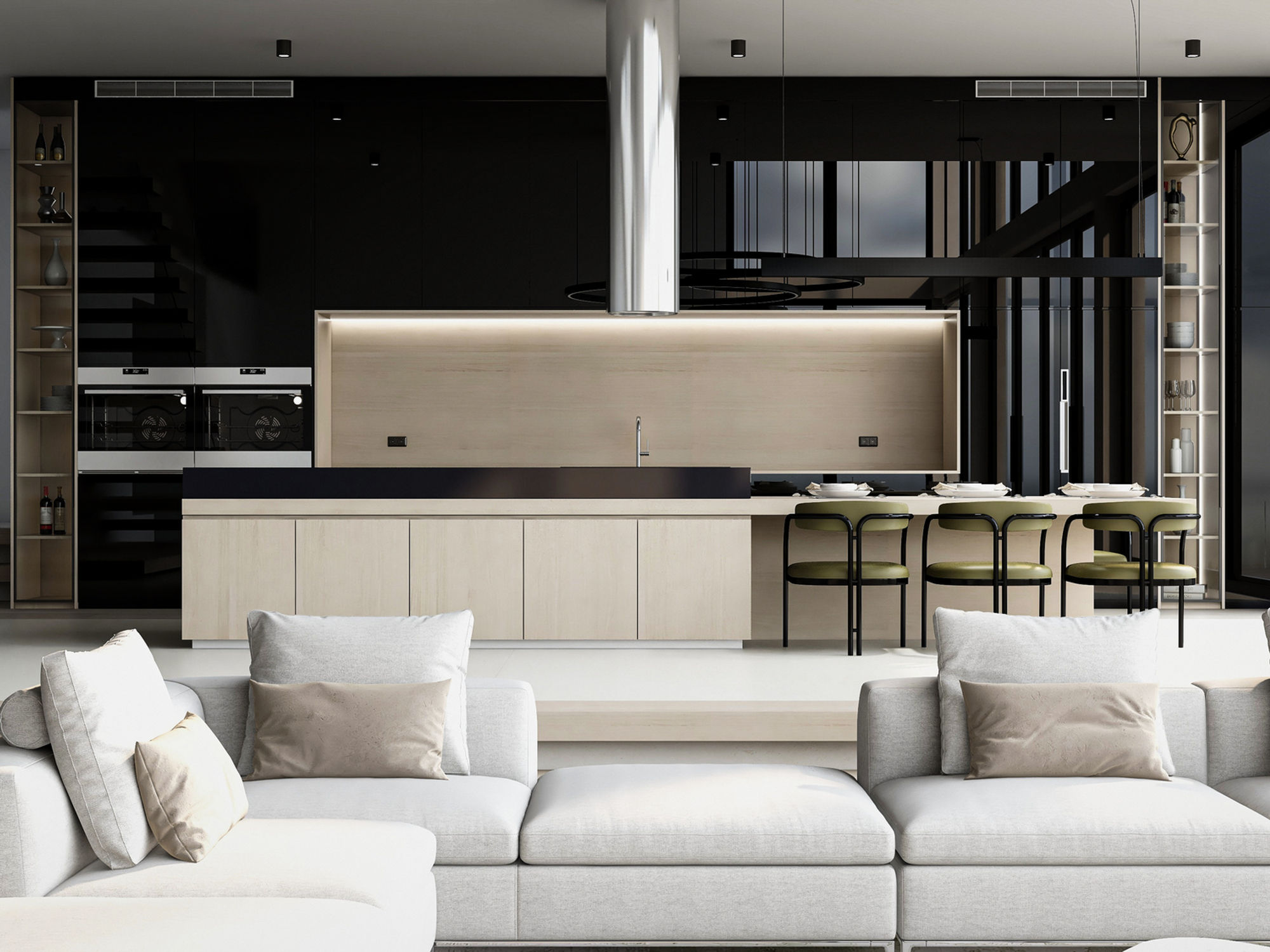
Hardware is the detail that makes or breaks a cabinet program. A kitchen in white lacquer with the wrong pull (too small, wrong finish, wrong profile) reads as unresolved. The same kitchen with the correct hardware reads as finished. It is not a subtle difference. A designer can identify the hardware choice in a kitchen photograph from across the room, because the hardware determines whether the cabinet reads as designed or as assembled.
In the DC market in 2026, the hardware decision has become more consequential as the cabinet finishes themselves have become more distinctive. The dark forest green kitchens, the white oak vanities, the two-tone island programs: each of these cabinet programs has a correct and an incorrect hardware pairing, and the clients who get the pairing right have kitchens that look intentional. Those who get it wrong have kitchens that look like the hardware was chosen after the fact, because it was.
This guide covers every dimension of hardware selection for DC kitchens and bathrooms: the hardware types, the finish options, how to pair hardware with cabinet finishes and countertop materials, how to size pulls correctly, and what the DC market is specifying in 2026.
Hardware types
Bar pulls (linear pulls)
The bar pull, a straight cylindrical or rectangular bar mounted on two posts, is the dominant hardware specification in DC custom kitchen programs and has been since frameless cabinetry became the standard. Bar pulls are clean, architectural, and suit the flat slab door profiles that are current. They are available in lengths from 3 inches (for a small drawer) to 18 inches (for a tall cabinet or a full-height door), and the profile (round bar, square bar, rectangular bar, tapered bar) is the first visual decision.
A round bar pull in an unlacquered brass finish is the current signature of the designed DC kitchen. A square-bar pull in matte black is the signature of the contemporary program. Both read correctly with flat slab doors. Neither reads correctly with a beaded or shaker door profile, where the ornamentation of the door and the severity of a bar pull compete.
Cup pulls
The cup pull, a U-shaped pull designed to be gripped from below, is the correct hardware for deep drawer faces. In a kitchen where the base cabinets are specified as full-height drawer banks (the correct specification for any drawer base), a cup pull on the bottom of each drawer face allows the drawer to be opened naturally without bending the wrist awkwardly upward. Cup pulls are most commonly specified in an unlacquered brass or an oil-rubbed bronze for programs with a traditional or transitional vocabulary.
Knobs
The knob is appropriate for door faces, not drawer faces: a knob on a drawer requires an awkward gripping motion and does not allow the force to be applied in the correct direction for a smooth opening. For door faces in a kitchen, a knob is appropriate in cabinet programs with a more traditional vocabulary: shaker profiles, beaded frames, or a kitchen designed to suit a house with 19th-century millwork.
In the current DC market, knobs on kitchen cabinets are specified less frequently than they were a decade ago. The frameless slab-door kitchen program that dominates McLean, Bethesda, and Georgetown does not suit a knob; the bar pull is the correct specification for this cabinet vocabulary.
Edge pulls (integrated handles)
Edge pulls (a shallow groove routed into the top or bottom edge of the door or drawer face, providing a finger grip without any protruding hardware) are the specification for the most minimal DC kitchen programs. An edge pull kitchen has no visible hardware: the cabinet faces are continuous surfaces interrupted only by the routed grip. This is the most expensive hardware specification because the routing must be precise and the door edge must be finished correctly to accept the grip. It is also the most visually demanding: every door and drawer face is fully exposed without hardware to draw the eye away from imperfections in the finish.
Recessed pulls
A recessed pull (a concave depression in the door face, sized for a finger or thumb) is appropriate for interior drawers, wardrobe systems, and pull-out components where a protruding pull would interfere with the cabinet’s closure. In a closet program with flush drawer fronts, a recessed pull allows the drawer to be opened without compromising the flat face of the wardrobe wall.
Hardware finishes: the 2026 DC market
Unlacquered brass
Unlacquered brass is the dominant hardware finish in DC custom kitchen programs in 2026 and has been gaining ground since 2021. The material, solid brass with no lacquer coating, develops a patina over time: the bright gold of a new pull slowly darkens and unevens, the contact points from daily use developing a warm worn quality while the recesses remain darker. The result, after two to three years of use, is a finish that looks like the kitchen has always been there: which is the design goal in a Georgetown Federal rowhouse or a Bethesda colonial that wants to feel settled rather than new.
Unlacquered brass pairs correctly with white lacquer cabinets, white oak veneer, Calacatta quartz and marble countertops, and warm white or cream painted walls. It does not pair well with cool gray cabinets or chrome fixtures: the warm yellow of brass and the cool blue of chrome compete in a way that reads as unresolved.
The maintenance implication of unlacquered brass is that it will change and cannot be cleaned back to its original brightness. Clients who want the brass look without the patina development specify satin brass, a lacquered finish that holds its color, instead. The satin brass is less distinctive but more stable.
Matte black
Matte black hardware is the correct specification for contemporary kitchen programs in cool-toned finishes: white lacquer with a gray or blue-gray undertone, dark charcoal cabinets, or two-tone programs with a white upper and charcoal lower. Matte black is graphic, severe, and reads as intentional in a kitchen with architectural vocabulary.
The pairing failure with matte black is warm-toned materials: white oak veneer, Calacatta marble, warm cream lacquer. In these programs, matte black hardware reads as too cool and too harsh. The correct hardware for warm programs is brass or bronze.
Matte black hardware requires more cleaning attention than brass or nickel: fingerprints are more visible on the matte black surface than on a patinated brass. In a kitchen used daily by a household with children, brass or brushed nickel is the more practical specification.
Brushed nickel and satin nickel
Brushed nickel is the neutral of the hardware world: it pairs with almost everything, offends nothing, and distinguishes nothing. It is the correct specification when the hardware should recede rather than be noticed: a kitchen where the countertop and cabinetry are the design statement and the hardware is not intended to contribute. It is also the most compatible finish for a kitchen where the appliances are stainless and the plumbing fixtures are chrome: nickel occupies the same cool-silver register.
Brushed nickel does not develop a patina. It holds its color and finish over time with minimal maintenance, which makes it the most durable hardware specification for high-use kitchens.
Satin brass
Satin brass, a lacquered brass that holds its warm gold color without patina development, is the specification for clients who want the appearance of unlacquered brass without the maintenance and change. It pairs with the same cabinet finishes as unlacquered brass and is appropriate for clients who prefer a more stable, predictable finish.
The visual difference between unlacquered and satin brass is evident in side-by-side comparison: the unlacquered has more visual depth and warmth; the satin reads as slightly more uniform and contemporary. Both are correct specifications; the choice is a matter of preference for change versus stability.
Oil-rubbed bronze
Oil-rubbed bronze, a dark brown finish with warm undertones, is the correct hardware specification for kitchens and bathrooms with a more traditional or Arts and Crafts vocabulary. In a Georgetown rowhouse with original millwork profiles, a shaker-profile cabinet in a warm white, and a soapstone or honed granite countertop, oil-rubbed bronze is the more appropriate specification than unlacquered brass or matte black.
Oil-rubbed bronze is less common in current DC kitchen programs than it was a decade ago, but it remains the correct specification in its specific contexts. It pairs with warm-toned stone, dark wood floors, and traditional millwork.
How to size pulls correctly
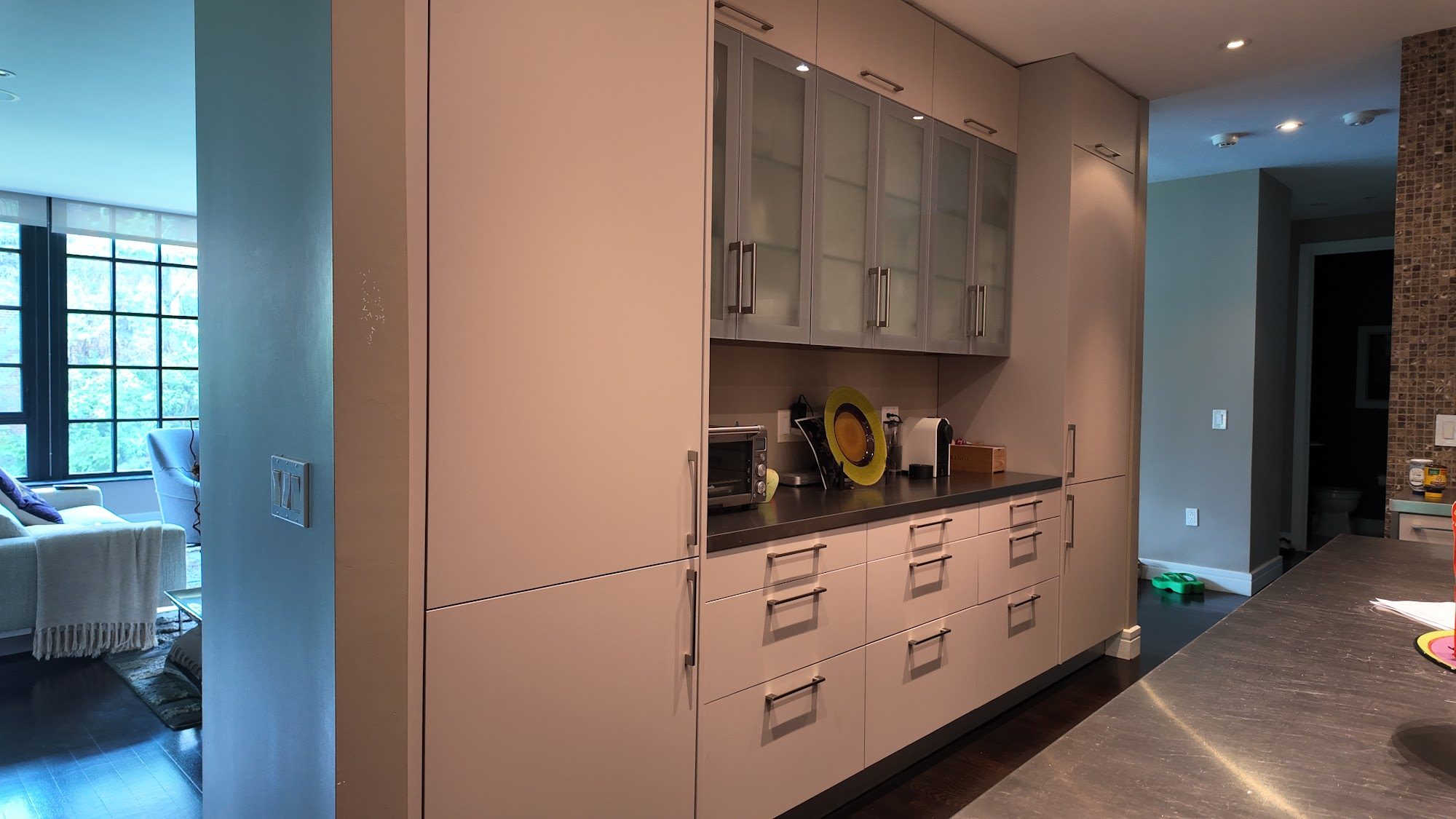
Pull length is the most common hardware sizing error in DC kitchen renovations. The default choice, a 4 or 5-inch pull for every door and drawer face, produces a kitchen that reads as under-scaled. The correct approach sizes the pull to the face it is mounted on.
Base cabinet drawers: A full-width base cabinet drawer face (typically 18 to 24 inches wide) needs a pull that reads in proportion. A 128mm (5-inch) pull on an 18-inch drawer face looks small. The correct pull for a wide drawer face is 160mm (6.3 inches) to 224mm (8.8 inches): wide enough to be grasped naturally at the center of the face.
Tall cabinet doors: A tall cabinet (a full-height pantry door, an integrated refrigerator panel, or a wardrobe door) needs a pull scaled to its height. A long vertical bar pull (12 to 18 inches) on a full-height door reads correctly. A small 128mm pull on the same door reads like an afterthought.
Upper cabinet doors: Upper cabinet door faces are narrower and shorter than base cabinets. A 96mm (3.75-inch) to 128mm (5-inch) pull is correct for a standard 15 by 30-inch upper door face. The pull should be centered horizontally on the face and positioned at a consistent height across all upper doors: typically 2.5 to 3 inches from the bottom edge of the face.
Consistency rule: All pulls in a kitchen should be from the same family (same profile, same finish), even if they are different lengths. Mixing round-bar and square-bar profiles in the same kitchen reads as inconsistent.
Hardware finish pairing guide
| Cabinet finish | Best hardware finish | Acceptable | Avoid |
|---|---|---|---|
| White / off-white lacquer | Unlacquered brass | Satin brass, matte black, brushed nickel | Chrome |
| White oak veneer | Unlacquered brass | Satin brass | Matte black, chrome |
| Dark lacquer (navy, green, charcoal) | Unlacquered brass | Satin brass | Matte black (disappears), chrome |
| Two-tone (white + dark) | Unlacquered brass throughout | Satin brass throughout | Mixed finishes |
| Fenix NTM | Matte black | Brushed nickel | Unlacquered brass |
| Sage / warm green lacquer | Unlacquered brass | Oil-rubbed bronze | Matte black, chrome |
| Shaker / beaded profile | Oil-rubbed bronze, unlacquered brass | Brushed nickel | Bar pulls (use knobs or cup pulls) |
Matching hardware to cabinet finish and countertop
The hardware finish does not exist in isolation: it is part of a material palette that includes the cabinet finish, the countertop, the backsplash, the plumbing fixtures, and the lighting. The correct hardware choice resolves all of these materials into a coherent palette.
White lacquer cabinets: The most versatile cabinet finish for hardware. Compatible with unlacquered brass (the most common pairing), matte black (for contemporary programs), brushed nickel (for a clean neutral), and satin brass. The plumbing fixtures and pendant lighting should match or intentionally contrast the hardware finish: mixing unlacquered brass pulls with chrome faucets reads as uncoordinated.
White oak veneer cabinets: Unlacquered brass is the correct specification: the warm metal suits the warm wood. Matte black on white oak reads too harsh. Brushed nickel on white oak reads as cold. Satin brass is an acceptable alternative.
Dark lacquer (navy, forest green, charcoal): Unlacquered brass is the classic pairing: the warm gold against the dark background is the combination that has defined the designed dark kitchen of the past five years. Matte black hardware on dark cabinets disappears and loses its purpose. Satin brass is the lower-contrast alternative.
Two-tone programs: The hardware finish should be consistent across both colors: one finish for the whole kitchen, not one for the light and one for the dark. The hardware is what visually ties the two cabinet colors together.
Countertop coordination: The countertop’s undertone should inform the hardware direction. Calacatta quartz and marble, warm gray veining on white, suits brass. Dekton Sirius (cool concrete) suits matte black or brushed nickel. White Macaubas quartzite (crystalline warm white) suits brass or satin brass.
Blum hinges: the hardware no one sees
The visible pull is the hardware the client chooses; the hinge is the hardware the cabinetmaker chooses. In a Pannello kitchen or closet program, every door uses Blum Clip-Top hinges with integrated Blumotion soft-close damping. This is not a specification the client needs to research: it is the standard, because Blum is the most reliable hinge hardware in the world and the soft-close performance is consistent over 200,000 cycles.
The practical implication: a Pannello cabinet door closes silently and completely every time, for 20 years. A cabinet with lesser hinges develops a rattle within five years and a misalignment within ten. The hinge is the most used hardware in the kitchen, a lower cabinet door opens and closes five to ten times per day, and the quality difference compounds over time.
Overlay: Blum Clip-Top hinges are available in three overlay formats: full overlay (door covers the full face of the cabinet box, appropriate for frameless construction), half overlay (door covers half the face, used where two doors meet at a shared partition), and inset (door sits flush within the cabinet frame, for face-frame programs). Pannello specifies full overlay on all frameless kitchen programs.
Opening angle: Standard Blum hinges open to 110 degrees. For corner cabinets and base cabinets where the door needs to open past an adjacent cabinet or appliance, 165-degree hinges are specified: the door swings fully back, parallel to the cabinet side, providing unobstructed access to the interior.
Bathroom hardware: different context, same principles
Bathroom cabinet hardware (vanity pulls, medicine cabinet handles, and linen cabinet pulls), follows the same material and sizing principles as kitchen hardware, with one additional consideration: the plumbing fixtures.
In a primary bath, the faucet, towel bars, toilet paper holder, and robe hooks are all visible simultaneously with the vanity hardware. The hardware finish needs to resolve against this full fixture palette, not just against the cabinet. A primary bath with a wall-mount faucet in unlacquered brass, a free-standing tub filler in the same finish, and matte black cabinet pulls reads as having two separate design intentions. The correct specification resolves all metal to a single finish family.
The most common bathroom hardware specification in current Pannello DC primary bath programs: unlacquered brass pulls on white oak or white lacquer vanity, unlacquered brass faucet and plumbing fixtures, unlacquered brass towel bars: a fully coordinated warm metal program that reads as a single design decision.
For Fenix NTM vanities, a specification the bathroom vanity guide covers in detail, matte black hardware is the typical pairing. Fenix’s ultra-matte surface and the graphic quality of matte black hardware share a material vocabulary that reads as intentional.
What hardware costs in a DC kitchen renovation
Hardware is a meaningful line item in a full kitchen program: not the largest, but not negligible, particularly at the top of the market.
Entry-level: Asian-manufactured pulls in basic finishes (chrome, brushed nickel) run $3 to $12 per piece. A kitchen with 40 to 60 pieces of hardware (drawers and doors) costs $120 to $720 in hardware material. These pulls are appropriate for a budget renovation and are available at most hardware retailers.
Mid-market: American and European manufacturers (Top Knobs, Amerock, Emtek) in quality finishes run $12 to $35 per piece: $480 to $2,100 for a 40 to 60-piece kitchen. The finish quality, the weight, and the consistency of the product are noticeably better than entry-level.
Premium: European specialty hardware (Armac Martin, Corston, Buster + Punch) and custom or hand-finished brass pieces run $35 to $120 per piece: $1,400 to $7,200 for a full kitchen program. At this level, the hardware is itself a designed object: weight, texture, and finish quality that is perceptible in use. For a $100,000+ Pannello kitchen program, spending $2,000 to $4,000 on hardware is a proportionate investment.
Pannello sources hardware from a curated list of suppliers across all three tiers and presents options in the showroom during the specification stage. The hardware selection is made against the actual door and countertop samples, not from a catalog, so the finish interaction is evaluated in real conditions.
Frequently asked questions
What is the most popular cabinet hardware finish in DC kitchens right now?
Unlacquered brass is the most-specified finish in current Pannello DC kitchen programs, followed by matte black for contemporary programs and brushed nickel for transitional and neutral programs. Satin brass is growing as an alternative to unlacquered brass for clients who prefer a more stable finish.
Should my kitchen pulls and bathroom pulls match?
Not necessarily, but they should be harmonious. If the kitchen has unlacquered brass pulls, the primary bath can have unlacquered brass or satin brass: the same finish family, possibly a different profile. A complete mismatch (brass kitchen, chrome bath) reads as two separate design decisions rather than one house.
How long should my cabinet pulls be?
Scale to the face: 96–128mm for upper cabinet doors, 128–160mm for standard base drawers, 160–224mm for wide base drawers, and 300–450mm for tall pantry or integrated appliance doors. Consistent pull length across all faces of the same type (all upper doors the same length, all base drawers the same length) is the rule.
Does Pannello supply the hardware or do I source it myself?
Pannello supplies and installs hardware as part of the cabinet program. We present options in the showroom against the actual door samples and coordinate the final selection as part of the specification review. Clients who have already selected specific hardware can bring that to the consultation for confirmation and inclusion in the program.
Can I change the hardware after the cabinets are installed?
Yes: hardware is the easiest element of a kitchen to change after the fact. The existing screw holes can be filled and redrilled for a different center distance, or a new pull with a larger backplate can cover the existing holes. The limitation is that the new pull must have the same or a larger hole spacing than the existing, or the existing holes must be filled and refinished.
Related reading: Custom kitchen cabinets in Washington DC, 2026 guide · Custom bathroom vanities in Washington DC, 2026 guide · Countertops in Washington DC, 2026 guide.