
July 27, 2026
Wallpaper installation in Chevy Chase MD: designer wallcoverings for historic homes (2026)
A complete guide to wallpaper and designer wallcovering installation in Chevy Chase, Maryland, what patterns and materials suit Tudor Revival and Colonial Revival homes, how installation differs from standard contractor work, and what Chevy Chase programs cost in 2026.

Chevy Chase, Maryland is not a neighborhood you drive through: it is a neighborhood you arrive at, live in, and rarely leave on weekends. The houses along Grafton Street, Maple Avenue, and the streets running north from Western Avenue are mostly from a specific construction era: 1910 to 1945, Tudor Revival, Colonial Revival, and Craftsman bungalows built at a scale and material standard that the post-war suburbs never matched. Plaster walls. Plaster ceilings with original crown molding. Ten-foot ceilings in the formal rooms and eight-foot ceilings in the upper halls. Door surrounds with pilasters. Chair rail that was put there to protect actual plaster from actual dining chairs, not as a decorative afterthought.
These houses reward wallpaper. The wall surface is large enough to read pattern correctly: a wallpaper that would overwhelm a new-construction room with 8-foot ceilings and no moldings reads correctly when set against a Chevy Chase plaster wall with picture rail above. The architecture provides the frame. The wallpaper provides the interior.
This guide covers what wallpaper and designer wallcovering installation looks like in Chevy Chase, Maryland specifically: the housing conditions, the pattern and material choices that suit the architecture, what installation at this level costs, and how to avoid the common mistakes that are especially costly in a house with original plaster.
Why Chevy Chase homes are unusually good candidates for wallpaper
The answer is in the architecture. The 1920s Colonial Revival on East Kirke Street has a formal dining room approximately 14 by 16 feet, with 9-foot 8-inch ceilings, original plaster walls with chair rail at 34 inches, and picture rail at 84 inches. The wall section between chair rail and picture rail, 50 inches of height by the width of the room, is precisely the zone where a traditional wallpaper with a mid-scale botanical or stripe pattern operates correctly.
The same pattern in a new-construction Bethesda Colonial with 9-foot drywall walls and no moldings looks flat. The same pattern on an original Chevy Chase plaster wall with chair rail framing it below and picture rail above looks designed: because the architecture was designed to receive it.
Three specific features of Chevy Chase housing stock make wallpaper work well here:
Original plaster walls. Plaster is harder, denser, and flatter than drywall: the surface takes wallpaper adhesive correctly and the wallpaper sits flat against it. Papering over drywall requires primer, skim coat, and careful preparation; papering over sound original plaster requires less preparation and produces a better finished result. Most Chevy Chase homes from the 1910–1945 period still have original plaster in the formal rooms, even if the kitchen and bathrooms have been renovated.
Room scale. The formal rooms of a Chevy Chase Tudor Revival (the living room, the dining room, the entry hall) are at a scale that accommodates large-pattern wallpaper and architectural wallcovering. A dining room of 180 square feet with 10-foot ceilings has enough wall surface for a large botanical or a trellis pattern to repeat correctly and read at distance. Smaller rooms with lower ceilings compress large patterns in a way that reads as overwhelming.
Existing moldings. Chair rail, picture rail, crown molding, and door surrounds give the installer natural stopping and starting points. A wallpaper does not have to terminate at the ceiling in a mitered corner against crown: it terminates at the picture rail, below the crown. The transition is resolved by the architecture, not by the installer’s ability to cut a perfect miter.
Chevy Chase MD: neighborhood conditions that affect installation
Chevy Chase straddles the DC–Maryland line. The Maryland side (Chevy Chase, MD, the town itself and the unincorporated area north of Western Avenue) has its own permit conditions and housing character separate from the DC side (Chevy Chase DC, which is in Ward 3) and the Virginia suburbs. Most of what follows applies to Chevy Chase MD: the Town of Chevy Chase, Chevy Chase Village, Chevy Chase View, and the adjacent areas including Somerset, Martin’s Additions, and Kensington.
Access: The streets in original Chevy Chase MD are lined with mature trees (American elms, red oaks, pin oaks) and the houses are set back on substantial lots. Parking for a work crew is generally not the constraint it is in Georgetown or Dupont Circle. Installation trucks can typically park at the house, which matters when wallpaper rolls, paste tables, and scaffolding are being moved in and out.
Plaster condition: The plaster walls of original Chevy Chase homes are generally in good condition in the formal rooms: they have not been disturbed by the utility chases and HVAC retrofits that affect plaster in rowhouses. The areas to check are the upper-story rooms and any room where there has been a roof leak. Plaster that has absorbed moisture from a past leak will have soft spots, loose keys, and surface delamination that need to be addressed before papering.
Previous wallpaper layers: Many original Chevy Chase homes were papered multiple times in the 20th century. It is common to find two or three layers of wallpaper on the dining room walls: applied over the original plaster in successive renovation programs from the 1940s through the 1980s. Stripping these layers requires patience and the correct tools; rushing the stripping damages the plaster. Pannello’s installation crew includes experienced strippers who work to remove old layers without cutting into the plaster face.
Humidity cycling: Chevy Chase MD has a continental climate with hot, humid summers and dry winters. The humidity cycling (80% relative humidity in August, 20% in January) is harder on wallpaper than the more moderate conditions of a climate-controlled new-construction home. Wallpaper specified for Chevy Chase should be a paper-backed or non-woven substrate that handles dimensional movement in the substrate. All-vinyl papers are more stable but less appropriate for the housing stock. Non-woven papers, a synthetic fiber substrate that does not expand or contract with humidity, are the most appropriate specification for Chevy Chase historic homes.
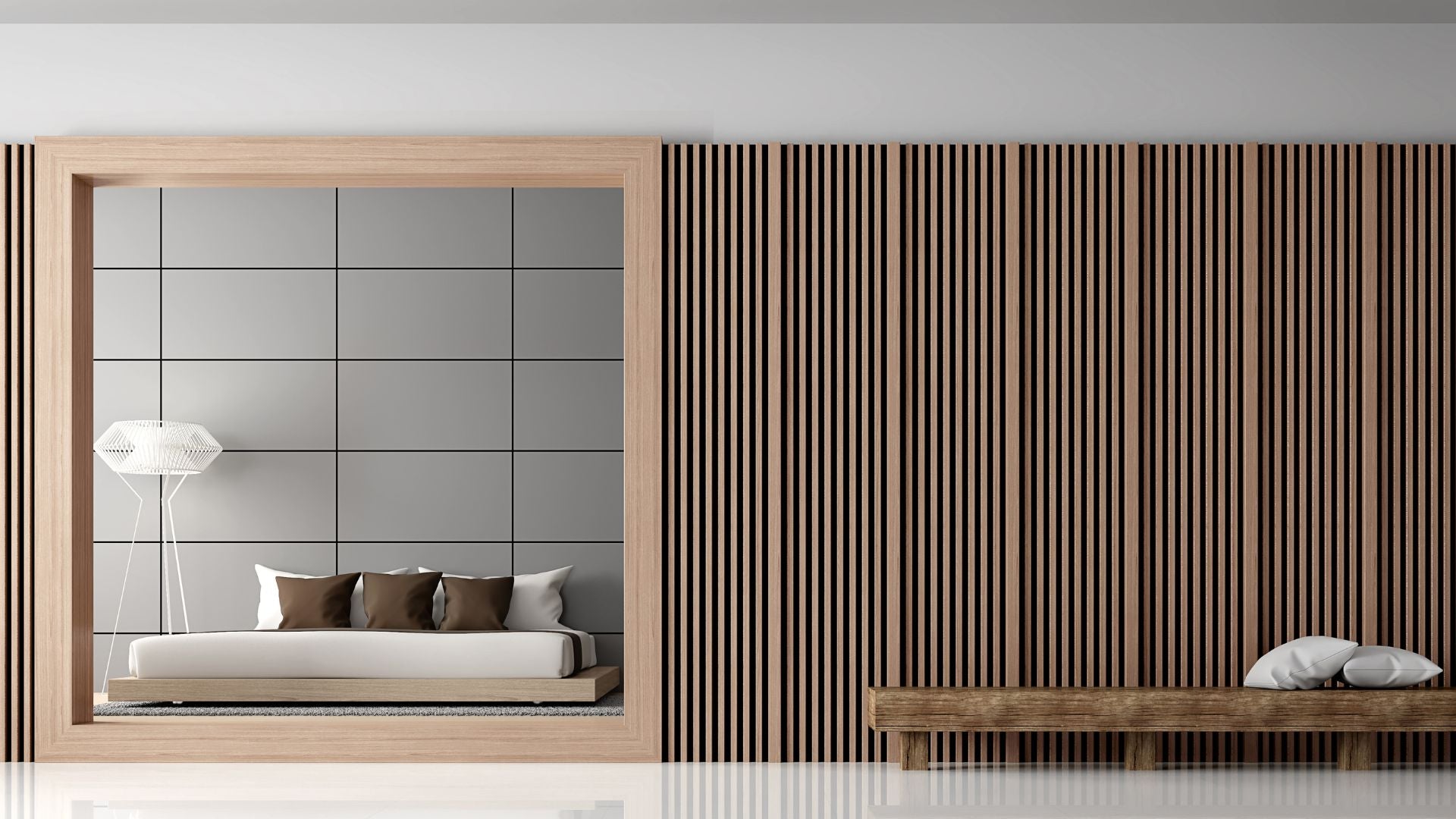
Pattern families that suit Chevy Chase Tudor Revival and Colonial Revival homes
The pattern selection for a Chevy Chase historic home is not the same as for a Georgetown rowhouse or a McLean colonial. The specific architectural vocabulary of the Chevy Chase housing stock, particularly the Tudor Revival and Colonial Revival types, has a pattern vocabulary that suits it.
Large-scale botanical and chinoiserie
The formal dining room and living room of a 1925 Chevy Chase Colonial Revival are the natural context for large-scale botanical wallpaper: the Zuber-style scenic, the hand-printed botanical, the William Morris large repeat in a colorway appropriate for the room’s light and proportion. These rooms have the ceiling height to accommodate a 27-inch or larger vertical repeat without the pattern being cut off at the ceiling, and the wall area to show the pattern repeating across a complete section.
Current Chevy Chase specifications that Pannello has installed: Cole & Son’s Botanical Collection in a dark teal colorway for a south-facing dining room on Leland Street; Farrow & Ball’s large-scale prints in “Silvergate” for a master bedroom on Maple Avenue; Schumacher’s “Shantung” grasscloth in a deep ochre for a study with bookshelves flanking the window.
Stripes and geometric patterns in formal halls
The entry hall of a Chevy Chase Tudor Revival, typically a center-hall plan with a staircase visible from the front door, is one of the most rewarding spaces to paper in the DC area. The vertical surfaces of the stair wall and the upper hall are often 14 to 18 feet in height measured from the ground floor to the upper hall ceiling, giving enough height for a full-scale stripe or a geometric repeat to read at scale.
A wide stripe, 4 to 6 inches per stripe, in two tones of a single color (navy and off-white, deep green and cream, burgundy and sand) reads correctly in a Chevy Chase center-hall plan because the architectural scale supports it. The same stripe in a small entry hall reads as overwhelming. The available height in the stairwell is what makes the pattern work.
Grasscloth and natural fiber wallcovering in libraries and studies
Many Chevy Chase homes of this era have a dedicated library or study: a room with built-in bookshelves, a fireplace, and a more intimate scale than the formal rooms. Grasscloth or jute wallcovering in this room type provides texture and warmth appropriate to the room’s function without competing with the books and architectural details.
The limitation of grasscloth in Chevy Chase is the humidity issue: natural fiber papers expand and contract with the seasonal humidity cycling more than non-woven papers. The seams in a grasscloth installation in Chevy Chase may open slightly in the dry winter months. This is managed by specifying a backing paper beneath the grasscloth (which stabilizes the substrate) and by selecting a woven pattern whose seam is naturally less visible than a smooth-paper seam.
Textured papers and linen weave in bedrooms
The upper-story bedrooms of Chevy Chase homes are typically smaller and more modest than the formal rooms below: 12 by 14 to 14 by 16 feet, with 8-foot ceilings, simpler moldings. In these rooms, a textured paper (linen weave, rough-surface non-woven, cork paper) provides interest without the pattern commitment of a large-repeat botanical. The texture reads in normal room lighting and disappears in photographs, which suits a room whose primary purpose is sleep rather than display.
| Pattern family | Best room type | Ceiling height needed | Humidity consideration |
|---|---|---|---|
| Large-scale botanical | Dining room, living room | 9 ft+ | Non-woven backing recommended |
| Wide stripe / geometric | Center-hall stairwell | 12 ft+ | Standard non-woven |
| Chinoiserie / scenic mural | Dining room, powder room | 9 ft+ | Non-woven or paste-the-wall |
| Grasscloth / jute | Library, study | Any | Back-lined for humidity |
| Textured / linen weave | Bedroom, upstairs hall | Any | Standard non-woven |
| Slat wall / 3D panel | Family room, accent wall | Any | MDF-based, stable |
What professional wallpaper installation involves in a Chevy Chase home
The installation process in a Chevy Chase original home is materially more involved than installation in a new-construction house. Understanding the steps helps set realistic expectations for timeline and cost.
Step 1: Wall assessment. Before any material is ordered, Pannello measures the room and assesses the wall condition. Original plaster walls are checked for soft spots (tapping the surface and listening for the hollow sound that indicates a key failure), staining from past moisture events, and adhesion of any existing wallpaper layers. The assessment determines whether any repair or removal work is needed before papering can begin.
Step 2: Stripping and repair. If there are existing wallpaper layers, they are stripped using steam and warm water, working in sections to minimize moisture contact with the plaster at any one time. After stripping, any damaged plaster (soft spots, holes from removed hooks or picture rails, cracks at corners) is repaired with joint compound and allowed to cure fully. Rushing the cure produces a repair that is visible through the new wallpaper.
Step 3: Wall sizing. Original plaster is sized (coated with a diluted adhesive or primer) before papering. Sizing seals the plaster surface and ensures even adhesion across the wall: the wallpaper paste bonds to the size coat uniformly, rather than being absorbed unevenly by the plaster.
Step 4: Pattern layout. Before the first strip is cut, the pattern is laid out on the wall in pencil to confirm where each repeat falls, where the seams land relative to windows and doors, and where any partial repeat will be least visible (above the door, at a corner). In a room with a large-scale botanical, this layout step prevents the pattern from centering awkwardly or seaming in a visually prominent location.
Step 5: Hanging. Non-woven papers are hung by applying paste to the wall (paste-the-wall method) rather than to the paper: the paper is dry when hung and is repositionable for alignment before the paste sets. Traditional papers are paste-the-paper and require booking (folding the pasted paper back on itself to allow it to relax before hanging). The method depends on the paper specification.
Step 6: Trim and finishing. Each strip is trimmed at the ceiling, chair rail, picture rail, and baseboard with a straight edge and a sharp knife. In a room with crown molding, the trim line is at the junction of the molding’s lower return, not at the ceiling plane: the molding covers the raw edge. In a room with picture rail, the paper terminates at the top of the rail.
Step 7: Seam inspection and touch-up. After the room is complete and the paste has dried (typically 24 to 48 hours), each seam is inspected in raking light. Any seams that have lifted are re-adhered with seam adhesive. The completed installation should show no seams at normal viewing distance from the center of the room.
Slat walls and 3D wall panels in Chevy Chase homes
Not every room in a Chevy Chase home calls for traditional wallpaper. The family room addition at the rear of the house, typically a 1970s or 1980s addition to an original 1920s structure, often has 8-foot ceilings, drywall surfaces, and an informal character that suits a different type of wall treatment.
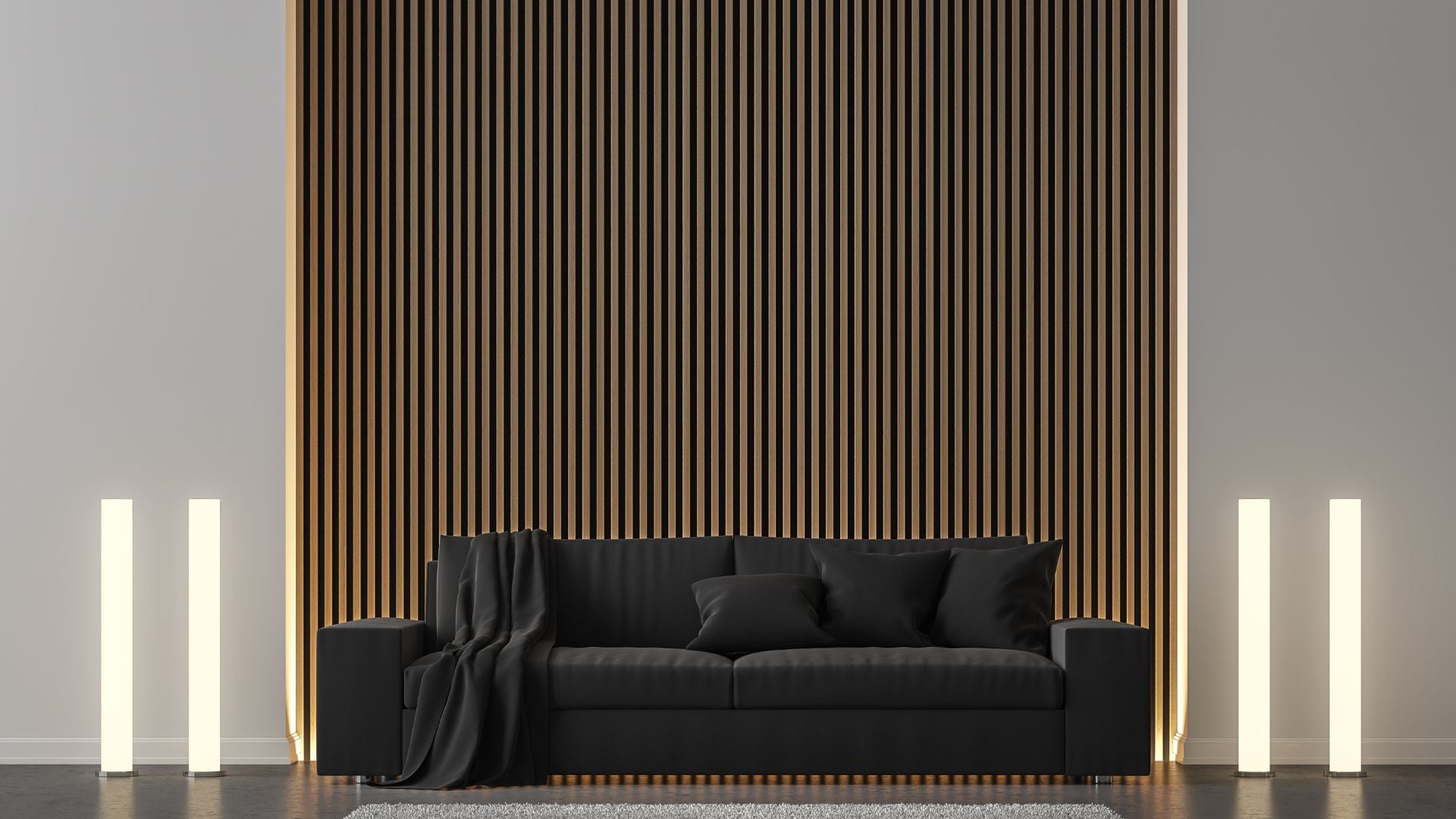
Slat wall panels (linear MDF strips in a warm finish, installed vertically on the wall surface) are the current specification for family room and media room accent walls in Chevy Chase renovations. They provide texture and warmth that drywall cannot, they can be painted or stained to coordinate with the room’s cabinetry, and they are more durable than wallpaper in a room with casual daily use.
Pannello has installed slat wall programs in several Chevy Chase family rooms. The typical program: a full accent wall behind the media console, 3 to 4 inches of slat width with 1-inch gaps, finished in a warm white or a light oak stain. The slat wall reads as an architectural element rather than a decoration: it anchors the media wall and provides the visual interest that the original part of the house gets from its moldings.
Coordinating wallpaper with Chevy Chase’s existing woodwork
One of the most consequential decisions in a Chevy Chase wallpaper program is how the paper relates to the existing painted woodwork. The trim in a 1920s or 1930s Chevy Chase house is typically painted, historically in a gloss or semi-gloss white or off-white, and its profile (the crown molding section, the door surround pilasters, the base cap and base) is substantial by modern standards.
The wallpaper does not compete with this woodwork. It coexists with it. The relationship between the paper pattern and the trim color is the first decision to resolve, and it drives everything else.
Dark paper, white woodwork: The most common and most clearly resolved relationship. A deep teal or navy botanical on the dining room walls, with the existing white crown and door surrounds, reads as a finished interior because the contrast is intentional and complete. The white woodwork frames the pattern and gives the eye a resting point. This is the relationship most often specified in Chevy Chase colonial revival dining rooms.
Paper with matching woodwork paint: An alternative approach is to repaint the woodwork in a color drawn from the wallpaper: the darkest value in the pattern, or one of the background colors. This produces a more enveloping room where the wallpaper and the woodwork are one continuous color program rather than contrast. The risk is that if the paint color and the paper color are close but not identical, the difference is noticeable. If they are matched precisely, the result is very resolved.
Wallpaper below the chair rail only: In a room with chair rail, the paper can be specified for the zone below the chair rail only, the dado, with paint above. This reverses the traditional arrangement (paint below, paper above) and works particularly well when the paper is a bold pattern that would overwhelm the full wall height but is contained and readable at the dado. A Chinoiserie at dado height in a Chevy Chase dining room, with painted plaster above, is a restrained and very specific design decision.
Understanding these relationships before ordering material prevents the most common mistake: choosing a beautiful paper in isolation without considering how it will read against the specific trim color and profile in the actual room.
What wallpaper installation costs in Chevy Chase MD (2026)
What drives costs higher in Chevy Chase: Stripping multiple existing wallpaper layers adds $300 to $800 per room. Plaster repair after stripping adds $200 to $1,200 depending on damage extent. Scaffolding for a stairwell over 14 feet adds $400 to $800. High-end papers (hand-printed, specialist imported paper) add significantly to material cost: the paper itself on a Chevy Chase dining room with Cole & Son or Zuber may run $1,200 to $4,000 for material alone.
What is always separate from the wallpaper cost: Painting of moldings and woodwork (if scheduled alongside the papering), electrical fixture removal and reinstallation, and any cabinet or built-in work in the same room. Coordinating these trades efficiently is part of Pannello’s project management role when the wallpaper is part of a larger renovation.
How to choose a wallpaper installer in Chevy Chase MD
The distinction between a general painter who hangs wallpaper and a dedicated wallpaper installer matters more in Chevy Chase than in most DC-area markets, because of the historic housing conditions: original plaster, existing layers, tall stairwells, and patterns with large repeats that require precise layout.
Things to verify before hiring:
Experience with original plaster. Ask specifically: “Have you installed on original plaster walls in historic homes?” The answer should include familiarity with sizing plaster before hanging, assessing plaster condition, and working around picture rail rather than trimming at the ceiling.
Pattern layout process. A competent installer lays out the pattern in pencil on the wall before cutting any strips. Ask how they determine where the first strip goes and how they handle the pattern repeat at corners. An installer who does not layout the pattern before cutting will produce a result where the pattern falls awkwardly at the most visible wall section.
Non-woven handling. Non-woven papers (paste-the-wall) are handled differently from traditional papers (paste-the-paper). An installer who pastes the paper rather than the wall for a non-woven product has not worked with non-woven material before. In a Chevy Chase home where the papers are likely to be non-woven for humidity reasons, this matters.
References in the neighborhood. Ask for references from Chevy Chase MD or adjacent Bethesda/Kensington/Somerset projects. The housing conditions in this area are specific enough that experience in new-construction Tysons Corner or Capitol Hill rowhouses does not fully translate.
Frequently asked questions
Can wallpaper be installed directly on original plaster walls in a Chevy Chase home?
Yes, and it is often the better surface for wallpaper than drywall. Original plaster is harder and flatter than drywall. It requires sizing (a diluted adhesive coat) before hanging, which seals the surface and produces even adhesion. Plaster in good condition (no soft spots, no past moisture damage) takes wallpaper very well. Damaged plaster needs repair before papering.
How do I remove old wallpaper from plaster walls without damaging the plaster?
Carefully, with steam and warm water applied in sections. The steam softens the adhesive in the old wallpaper, and the paper is removed in sections rather than pulled away quickly. Rushing the removal, pulling the paper without softening the adhesive, damages the plaster face. A professional installer in a Chevy Chase home will spend significantly more time on removal than a contractor who treats it as a quick prep step.
What wallpaper works best in a humid Chevy Chase home in summer?
Non-woven (paste-the-wall) papers are the most stable choice for the DC humidity cycle. They do not absorb moisture and expand in summer the way traditional paper-backed wallpapers do. Grasscloth and natural fiber wallcoverings are beautiful but require a backing paper and will show seam opening in dry winter months: this is expected with the material and not a defect, but should be understood before specifying.
How long does wallpaper installation take in a Chevy Chase dining room?
A dining room of approximately 250 square feet of wall surface with a large-scale botanical pattern (including layout, hanging, trimming, and seam finishing) takes 1.5 to 2.5 days for an experienced installer working alone. If stripping existing layers is needed, add 0.5 to 1 day. If plaster repair is needed after stripping, add another day for the repair to cure before hanging begins. The full sequence from first day on site to completed installation is typically 3 to 5 days.
Does Pannello do the wallpaper selection and sourcing as well as installation?
Yes. Pannello works with the homeowner or their interior designer on pattern and material selection and sources papers from Cole & Son, Schumacher, Farrow & Ball, Phillip Jeffries, Osborne & Little, and other vendors. We can also install client-supplied paper. When sourcing paper, we order a minimum of 10% overage over the measured requirement to account for pattern repeat waste and any strips that need to be replaced.
Do I need to remove furniture from the room before installation?
Movable furniture should be removed or moved to the center of the room: the installer needs access to all four walls. Built-ins and furniture that cannot be moved (dining room table and chairs that are too large to remove) can be worked around. The installer needs 3 to 4 feet of clear access to the wall surface at all times.
To discuss wallpaper or wall treatment installation in Chevy Chase MD: schedule a design consultation at our Georgetown showroom at 2201 Wisconsin Ave NW: approximately 20 minutes from Chevy Chase along Wisconsin Avenue.
Related reading: Wallpaper installation in Washington DC, 2026 guide · Custom cabinets in Washington DC, 2026 guide · Home office built-ins in Washington DC, 2026 guide.